Tuesday, April 22, 2008

OpenTable to hoi polloi: How was your meal?

Some time back, I ranted about calmly discussed my opposition to OpenTable's move to include user comments in restaurant listings.

A pointless act, I argued. Dining out is such a subjective experience; one man's delicious pasta feast is another man's nightmare of gluey fettucine, diluted pomodoro sauce and recycled salad. Which diner do you trust?

OpenTable's restaurant pages already include reviews from Gayot, Zagat's and
BoMag, which between them provide a reasonable cross-section of review experiences, both customer-generated and editorial.

So there's really no reason to ask OpenTable users to chime in with their opinions (other than corporate haste to echo the current marketers' mantra that social media is the shiny new way to engage customers).

Nevertheless, today I had two emails from OpenTable asking me to provide feedback on recent resto visits. Here's the first part of their survey form:
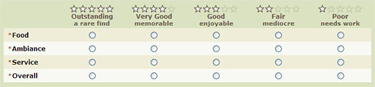


I like some of the adjectives they chose to define the star rating: "memorable," "enjoyable" and "needs work" are pretty distinct. But "a rare find" is ambiguous; i
s it a "rare find" if you go every month? Is it a "rare find" if the place is always busy, or only if no-one knows about it?

What about its rarity in the market? Is Elephant Walk "rare" by default, because it's the only French-Cambodian restaurant in Boston?

The second subjective section looks like this:
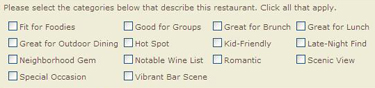


The problem here (apart from the dubiousness of phrases like "Hot Spot") is that some of these options only apply to specific diners. Would you check off "Good for Groups" unless you dined with a group? Or "Kid-Friendly" unless you'd had first-hand experience of the waitstaff's attitude toward your rugrats?


Does that mean that a place that actively welcomes families, but doesn't get as much feedback from them, will appear not to be kid-friendly?

(And you know me: I prefer not to have
people talking near my food, so I'm more likely not to encourage group dining, especially at places I enjoy. Keep 'em away, I say.)

Is "Neighborhood Gem" only valid if it's in your neighborhood (as
Tu y Yo is to us), or does it refer to any place within a clearly defined section of town? And if the latter, isn't every restaurant eligible for that category, regardless of location?
Is L'Espalier a "Neighborhood Gem"? When it reopens in the new Mandarin Oriental hotel this fall, will it still be a "Neighborhood Gem"? (Word on the street is No, but we can hope.)

Back to "Hot Spot." Their translation (I assume): "New place getting a ton of attention."

My translation: "New place getting a ton of attention. I give it six months."

The main issue with these classifications is their ambiguity, of which the first item, "Fit for Foodies," is a prime example. Does it mean the restaurant has unusual ingredients and dishes for the culinarily curious? Or that the menu choices are not so inventive but use organic or locally sourced ingredients? Or that the portions are gargantuan?
Not everyone defines "foodie" in the same way. So how useful a classification is this?

Similarly, "Notable Wine List" could mean an impressive selection of wines by the glass. Or it could mean a wide variety of prices. Or it could mean rare vintages only recognizable to dedicated oenophiles. Different customers, with different expectations, will make their own assumptions about the definition. And someone's likely to be disappointed with the restaurant and dubious of OpenTable's credibility.

So what descriptions would be more useful (read: useful to me)? How about:
  • Great for people-watching

  • Cute waitstaff

  • Hip, eclectic playlist

  • Has boudin

  • Serves random amuse-bouches

  • Tables not squished together

  • Barstaff understand that a true Martini is served really really cold
How about you? What categories would you find useful?

Labels: , , ,

Sunday, February 17, 2008

Restaurant website design: it's easy to be bad

Rest easy, my peoples: we have found our restaurant for Saturday evening in NYC. We'll be making a return trip to Wallsé, the rather lovely one-Michelin-starred Austrian place in the West Village. Thanks for your suggestions; they may come in handy for lunch!

It took a while for us to make a decision; OpenTable had 500+ restaurants in Manhattan alone with availability for next Saturday night, and even after dismissing a few categories whole-cloth (no steakhouse, no seafood, not French for a change), that still left a couple of hundred options.

So we started exploring. And we quickly realized there are a lot of bad restaurant websites out there.

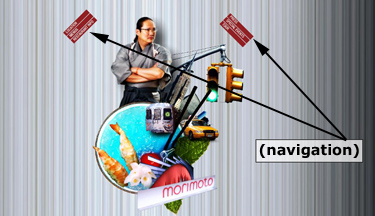
One great (or terrible) example is the all-Flash
Morimoto New York. First you have to click to launch the site. Then there's the ten-second delay while it loads. Then--like it or not--you get mood-setting music (hunt for the five-pixel-wide speaker icon to turn it off).

It looks like this (I added a hint so you can find the nav):


Click an option, and giant crab claws and Ginsu knives bum-rush the screen. The type size remains defiantly small.

While crafting this slick choreography of image and music, did anyone check, you know, the text?


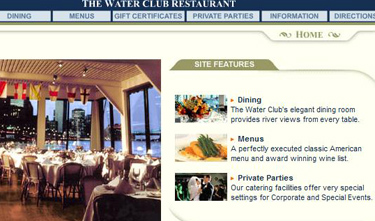
At
The Water Club, we find not so much a poorly designed restaurant website as a subtly strange choice of functionality. Say you're looking for a menu. Where are you most likely to click?


The item in the "Site Features" section won't help--nothing there is clickable, even though it's in the most eye-catching part of the page. For some reason, only the top nav is active. Stuff like this makes me wonder: if they don't know how to communicate with customers online, what will service be like tableside?

Oh, also, the FAQ section is "under construction." Is this because no one ever asks any questions?

But the prize for bad restaurant website design goes to AZZA Restaurant and Lounge, and not only because the reviews in the
press-clippings section skip away before you can finish reading them. No, this site goes above and beyond.

But don't take my word for it. Go check it out, and
take a look at the menu for yourself.

I'll wait here.

Labels: , , , , ,

Sunday, September 30, 2007

Don't take dining advice from strangers

I got email from OpenTable, asking if I'd take part in a user experience survey. Happy to help (and curious to see what they're plotting), I worked through a bunch of questions about booking a table through the site.

Toward the end of the survey was a list of future enhancements. What would you like to see on the site, they asked. One choice was "customer reviews."

No, I said. No, no, a dozen times no.

I know, that's what it's all about today: the interactivity. The social media. The Interwebs 2.0. Of course they have to consider it. And a site dedicated to helping people decide where to eat--well, that's a natural place to build community. What's more user-friendly than allowing people to share opinions about dining options?

Um, how about asking people to keep their opinions to themselves?

Don't get me wrong: I love finding out about new places. Tell me you celebrated a birthday, or spent a day on the North Shore, or took a trip to Chicago, and I'll ask, "Where did you eat?"

But I don't look for dining advice from people who post user comments.

Allow me to illustrate. This is a selection of
remarks about an Italian chain:

"We've enjoyed their food for years [...] it is delicious food and lots of it at great prices with fast and friendly service. "

"Service is slow, food served luke warm, overpriced ..."

"... huge portions of pretty good italian food. I've eaten there several times and the food is always fresh and tasty ..."

"What a huge pile of garbage. True, they give you enough food to feed an army, but who wants to eat any of that overcooked, preheated slop??"

See what I mean? One man's taste sensation is another man's pig swill. The only consistent observation here is that portions are gargantuan. Service, ingredients and pricing are all in flux.

Okay, fine. Maybe it's not fair to expect a unanimous chorus of praise for a pile-'em-high family-dining chain like Vinny T's. But what about a
small, independent bistro?

"The wait staff was attentive but not hovering. The food and its presentation were both sublime."

"Food was average and their attempt to make something extraordinary and fun [...] was very disapointing. The flavours were not at all complementing each other, if there were any flavours or taste what so ever."

"I felt we should have left the restaurant feeling satistfied. The only reason I wouldn't give this restaurant a 5 is the portions sizes, the food was excellent."

Food good! Food bad! Food good but insufficient!

At least the above restaurants have enough reviews to create a fairly meaningful average; the more comments there are, the easier it is to see which way the scale is tipping.

But what happens when there are only two posts--and a 50-50 split? For instance, if you were checking out a new place, how would
these two opinions help you decide?

"Quite simply a hidden gem in Jamaica Plain. I have dined here 3 times and the meals and service have been outstanding. "

"This place is terrible. The portions are small and overpriced. The room is tiny, overcrowded and noisy. The waiter was slow and sweated on my food and on my wife."

As these last two illustrate, one reason to stay away from user comments is that they tend to illustrate extreme points of view. Whether the experience was magical or appalling, it motivated these diners to sit down and write a report.

Add to that the concept of participation inequality--that, as my man Jakob Nielsen explains, only 1% of online community members post frequently, whereas 90% are lurkers who never post at all--and you get a see-through sliver of a sample size.

When the people speak, don't listen to them.

That's the detailed version of my response to the question. On the survey, however, the only note of my dissent was a checked radio button.

But tell me: am I over-reacting? Is a little community input a bad thing?

(Oh. See what I'm doing here? I'm asking for user comments! Talk about hypocrisy!)

Labels: , , ,

Thursday, May 03, 2007

When I am old ...

... I will spend all my spare time writing angry letters to the editors of various publications. Right now, though, my life is too full and exciting (bwa ha ha!), so diatribes are few and far between.

But last month's Boston Magazine article about OpenTable (which I ranted about here) prompted me to jot down a few thoughts (okay, spend a couple of hours obsessing over subtle wording and cunning emphasis) and email it to their letters page.

A week or so later, I got a nice message from one of their editorial assistants, asking for confirmation that I yam who I yam so they could print the letter.

And then--yay!--my rant made it into the May issue, almost completely unedited. They just took out one short phrase, which may give the impression that I'm impossible to please (no comments needed from The Boy, thank you!).

Anyway, as an editor myself, I'm really in no position to get ratty about other people doing exactly what I would have done myself.

On top of which, I have a lovely forum for rants right here, and no-one edits me except me.

Labels: ,

Saturday, March 31, 2007

OpenTable: the end of the reservation dance

I like to plan. For better or worse, I feel more comfortable about a situation if I know some of the variables are taken care of. Maybe it's fear of the unknown. Maybe my three months of Girl Scout involvement left an indelible "be prepared"-ness on my psyche.

Luckily, when it comes to food, I have help.

We've been signed up for
OpenTable since early 2004, and it's our first reference for any dining-out decision. This browser-based system allows the user to check out restaurants in advance and make reservations online.

For us, this is heaven: we can decide what time we want to eat, see which restos have availability, view their menus, and--click!--reserve a two-top.

How perfect is that? No trying to remember the name of that Cambodian place, you know, with the great lime-chicken soup. No falling back on the same restaurants over and over because you can't think of anywhere new. And best of all, no need to call half a dozen restos and do the reservation dance: "So do you have anything for 8:30 instead? Well, how about 9? 9:30?"

The system generates an email with confirmation, directions and parking details. You can send an invitation to others in your party. You can even arrange for flowers to await your date on the evening, if you're into that kind of thing.

When you show up for your meal, you're automatically awarded dining points (100 is the usual amount, though some places offer 1,000 if you book an off-peak time) that add to an overall total you exchange for a gift certificate ($10 per thousand points) redeemable at any resto on the system. A small incentive, but a nice one.

And OT's international scope means we can see what's going on in other cities. So if we're planning a trip to NYC, or Montreal, or London, we can scope out the options and book ahead. It pleases me to know there's a table at Union Square Cafe with my name on it.

Of course, OpenTable isn't a one-way street; it would be crazy to have all that customer data floating around uncorralled and unused. For the restaurants themselves, OT is a great
business management system. It allows them to track the flow of traffic, create marketing campaigns and--big savings--have the diners themselves, rather than an employee, take care of the reservations.

Another feature of the system is its function as a customer relationship management tool.

Apparently.

Both the OT website and
a piece in April's Boston Magazine note that the wealth of diner data allows restaurants to keep track of what customers have ordered on past visits; whether they're regulars; when they celebrate birthdays and anniversaries. This info can then be used to provide (according to BoMag) "exceptional customer service," making people feel welcome, remembered, special.

Apparently.

Maybe most restaurants don't yet feel the need to employ this aspect of the system. Maybe we're not eating at the kinds of places that include personalization in their philosophy of the customer experience. Or maybe maitre d's take one look at us and assume we're not worth the bother (always a possibility).

But in three years of booking through OT, we have yet to meet the waiter who acknowledges our return, offers us the cocktail we ordered last time, comments on the availability of the dessert we enjoyed so much.

The BoMag piece especially concerns me, as it gives the impression that a high level of CRM happens as a matter of course at every resto. Will this lead to a flurry of frustration, as people who sign up for the system with visions of VIP treatment find themselves handled like any other anonymous diner? And how will that affect their perception of the (blissfully unaware) restaurant?

For us, at least, there is a place where the waitstaff know us; where the owner will come over and discuss the origins of the week's special; where they ask when we'll next be coming in for breakfast.

But that's
Tu y Yo. We walk over there every other week. And they don't even take reservations.

Labels: , , ,