Thursday, April 22, 2010

Geo-food pop quiz time!

Props to O-Dogg for passing this along: an eye-catching promotion for the Sydney International Food Festival, as covered in Flavorwire.

The flags of countries, created from their iconic foods.

Can you name all 12?

Labels: , ,

Saturday, April 12, 2008

India with passion (without leaving the kitchen)

This may seem strange, coming from a Limey like myself, but I didn't begin to appreciate Indian food until I moved to the US. My experience with the cuisine growing up was that it was a test of endurance best exemplified by the seven-alarm vindaloo at the end of a lager-fueled night.

(The ne plus ultra of insanely hot curry is
Curry Hell, created by the late Abdul Latif, Lord of Harpole, who is best known for holding the Guinness World Record for long-distance takeout delivery from Newcastle, UK, to Sydney, Australia. If you finish the dish, it's free.)

I'd probably still harbor suspicions about Indian cuisine, were it not for the existence of such places as
Diva in Davis Square, which goes beyond curry and rice to such yummy dishes as tandoor-baked salmon, fried okra, and coconut-cardamom soup. They also have a fabulous cocktail of ginger-infused rum with mango juice and fresh lime, finished with a dash of cayenne pepper. Gives one's tongue a fruity tingle, it does.

While The Boy has become quite adept at throwing together a curry, he's been working from the same recipe for a while. So we picked up
India with Passion by Manju Malhi. The book splits the cuisine up by region and hits the high points of each. The recipes are reasonably straightforward (few are longer than this post so far).

As we'd pledged to eat healthily this week, we decided to try something veggie, so made both dal makhani and aloo gobhi. The former is a dish of black lentils simmered with kidney beans and spices; the latter involves cubed potatoes and cauliflower fried with onions and finished with fresh ginger. There was a small amount of prep for both (the fine chopping of pungent ingredients), and the lentils needed to soak for eight hours in advance, but everything came together pretty quickly.

The kitchen smelled wonderful: onions and garlic and chilis and ginger; turmeric and coriander and cumin and garam masala.
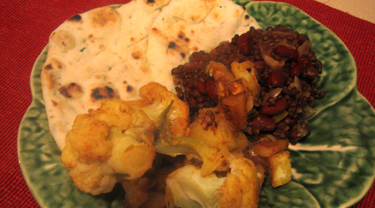


India with Passion is also edumacational: I learned that the vicious vindaloo of my youth came to India by way of Portugal--the name is a variation on vinh d'alho (i.e. garlic vinegar), a leftover from Portuguese colonization of the island of Goa.


The book also has chutney recipes (fig, apple, tamarind, garlic), as well as instructions for drinks such as mango lassi and a ginger lemonade with peppercorns and cumin.

Now, I don't want to promise anything, but if we try out a few more dishes, we might need some volunteer tasters ...

Labels: , , , ,

Thursday, March 20, 2008

What is ethnic food?

The first time we ate at A Salt and Battery, Manhattan's nostalgia-inducing (if unrealistically expensive) approximation of a good old Northern chippy, a woman at the next table looked at her companion over a basket of battered fish and exclaimed delightedly, "I just love ethnic food!"

I was shocked. Ethnic food? This wasn't ethnic; it was chips and pork pies and sausages and
Irn-Bru. It was the food of my childhood, as familiar and simple as a bowl of cornflakes. But to this woman, it was downright exotic.

Lately I've been thinking about this wake-up moment, especially in light of a couple of discussions currently taking place. One concerns
The Fortune Cookie Chronicles, Jennifer 8. Lee's (yes, her middle name is a number) exploration of Chinese food in America, and the way it's so far removed from authentic Chinese cuisine that it's almost unrecognizable to visitors from China.

The other revolves around changes to Britain's immigration policies, which have reduced the number of new arrivals from the Indian subcontinent while increasing the population of Eastern Europeans. As a result,
Indian restaurants, struggling to find cooks with first-hand experience of the cuisine, are instead hiring kitchen staff from places like Croatia. The concern is that knowledge of traditional techniques and recipes will disappear, or will eventually only be understood by a handful of old-timers.

And these discussions have me wondering: what is "ethnic"? What is "authentic"?

If, for instance, I asked you to name some ethnic cuisines, what would you say? Thai, Jamaican, Cambodian, Cuban? Mongolian and Nepalese? Yeah, they probably fall under the heading.

So does "ethnic" food mean "foreign" food?
What about Italian? That's foreign, right? Well, it depends what we mean by "Italian." Pizza is Italian, but does that mean
the excreta of Domino's can rightly stand shoulder to shoulder with the creations of Da Michele in Napoli?

Maybe Italian food isn't a good example; in the US, at least, it has largely been reduced to what Henry Hill in Goodfellas refers to as "egg noodles with ketchup"—a fast, cheap, indigestion-inducing way to carbo-load. Non-nativeness alone is not a strong enough distinction.

So does ethnic mean "alien, different, strange"?
What about French cuisine? It's decidedly alien, almost treacherously so (remember the hysteria over "Freedom Fries"? Could you imagine similar censorship over lasagne?). It's often hard to pronounce (Ris de veau renversé sur une tarte aux champignons et son jus de truffe, anyone?). It involves strange ingedients: frogs' legs and pigs' feet and tête de veau.

But it conjures up images of starched tablecloths and obsequious waiters and excellent wines—things we like to associate with sophisticated civility; things we're comfortable with (or imagine we should be). Different and strange don't necessarily work as sole identifiers of ethnic food.

So does "ethnic" mean "authentic"?
In the sense that ethnicity is a marker of belonging to a group, that could be more appropriate: it's the recipes handed down from mother to daughter, a transfer of internal, culturally relevant knowledge going back generations. (I'm thinking of the comforting, complex cochinita pibil at
Tu y Yo, from a family recipe dating back to 1908.)

And that brings in the idea that "real" ethnic food can only be created by the people who grew up with it. Which explains the concern over Bosnians standing in for Bangladeshis in the curry houses of Britain.

But on the other hand, authenticity is no guarantee of quality, in Indian cuisine or any other, as anyone who has valiantly masticated a gristly General Gau's will tell you. (Of course, as the above-mentioned Jennifer 8. explains, this dish is an American creation, unknown in the general's hometown. Still, provenance notwithstanding, a restaurant that screws up deep-fried battered chicken is unlikely to excel at other dishes.)

And does authenticity rest in the creation or the creator? If I make Puerto Rican habichuelas using Goya sofrito from a jar, is that less authentic than
my mother-in-law in San Juan following the same recipe, using the same brand? Does my Englishness negate the authenticity of the dish?

The conversation spilling from the kitchen at Davis Square's Irish pub,
The Burren, suggests the guys working the grill are more familiar with Quisqueya than Cork. Does that mean they can't knock together a fine English breakfast (not unlike this one)?

For that matter, do people think of Irish food as "ethnic"? Apparently so, if this selection of
Google search results is any indication. Oh, I'm so confused.

And then there's this
report from Deloitte, which defines ethnic food as representing "dishes (and their ingredients) that can be attributed to a specific ethnic group." Not a bad umbrella definition.

Wait—does that make me ethnic?

Labels: , , , , ,