Monday, October 27, 2008

Chip butties in Brighton!

I'm sure this does nothing to support my argument in favor of British food, but I was delighted to discover this tasty treat in Thrillist today:
From a family of Cork emigrees, The Battery's Boston's first "authentic Irish chipper," serving up homemade battered & fried deliciousness [...] The arterial onslaught starts with hand-cut "chips" in eleven styles (from homemade garlic mayo, to curry/mayo, to cheese/coleslaw) that're also available as a "Chip Butty" [...] old-school fish 'n chips [...] fried potato pies (cheese/onion, or thyme/parsley), battered sausage [...] Lucozade [...] Ribena ...
I am so there.

Labels: , , , , ,

Sunday, October 26, 2008

Au revoir, Craigie Street Bistrot

This is Craigie Street Bistrot's last week in its current subterranean location; the final service is happening as I write. Last night, we went to pay our respects. Much as L'Espalier made a move this summer from its Back Bay townhouse to the new-hotel-smell Mandarin Oriental, so CSB is moving across Cambridge to Main Street to take over the site formerly known as La Groceria.

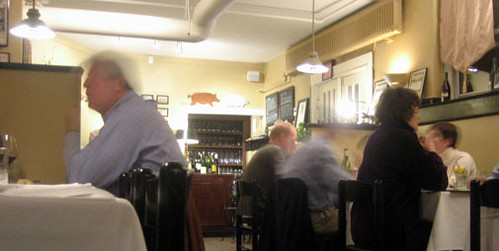
This is doutbless a relief for the kitchen crew; as with L'Espalier, the chefs at Craigie Street were pretty much working in a ship's galley. And similarly, the tight confines of the kitchen made it even more miraculous that they were able to create dishes of great delicacy, complexity and balance. The dining room isn't exactly cavernous, either.


The parallels between the two gave us a little trepidation. Our swan-song
visit to L'Espalier had been disappointing; would Craigie Street's standards also start slipping as they prepared to close the doors?

One sign that this was not going to happen: Young Tommy is now the bar manager.

Okay, I shouldn't call him that; it's just that he was one of the first kids I met when I started as a school volunteer 15 years ago. He was a 10-year-old who managed to be both bratty and charming, and now he's lost the brattiness (pretty much) and has become a
respected local mixologist who made a name for himself at Eastern Standard and is obviously destined for great things.

The school librarian, Jean (still one of my best friends), had high hopes that he'd become an astronaut; frankly, I think his chosen career path is a much greater service to humanity.

We settled in to read the menu, and then I recalled something I'd read in a CSB email about a wine. All I remembered was that it was made by re-using the lees after fermentation; that the result was either absolutely terrible or completely fantastic; that a recent vintage had been the latter; and that Craigie Street had the only 15 cases in the country.

"Oh yes," said our server, "you mean Noire." It was $68 a bottle, but we figured we might not get the chance again.

I'm not a sommelier. I'm getting more competent at pairing wine with food, I know what I like, I know what to expect from certain varietals. I don't have the vocabulary to explain Noire in wine terms, so I'll try this instead:

Usually, when I taste a wine for the first time, I can pinpoint certain fundamental flavors and characteristics—plum/spice/tannins; pepper/citrus/acidity; peach/minerals. It's like watching Murder, She Wrote and figuring out whodunnit in the first act.

By comparison, tasting Noire was like watching Memento: just when you think you know where it's going, it gives you more clues, different angles, unexpected revelations. Instead of responding to the first pour with (sip) ... beat ... "yes, that's fine, thanks," this was more like (sip) ... beat ... "wow ... oh, wait ... hold on ... oh my goodness ... oh ... um, this is amazing."


Oh, also, there was food. We both went for the prix fixe, with a couple of substitutions from the a la carte menu, and ended up with:

  • Tartare of citrus-cured Irish sea trout with sturgeon caviar
  • Banyuls-cured duck breast and fennel/pepper-cured lardo

  • Spanish octopus with fresh hearts of palm (possibly the best octopus I've ever had)
  • Ragout of cocks' combs and local mushrooms with a slow-cooked egg (I wiped the plate with bread; have I mentioned that I don't like mushrooms?)

  • Slow-roasted sweetbreads, marinated in yogurt and served with kohlrabi and turnips
  • Lamb: roasted loin, slow-cooked belly (a square of sweet fat), ragout of tongue
Throughout the meal, the wine changed, not just opening up as it breathed, but also being a chameleon to the flavors in the dishes, matching note for note against duck meat and fennel, chestnuts and kimchee.

And then dessert—it's included! How could we say no? The Boy had profiteroles with chocolate sauce and banana ice cream, and I had warm cornbread pain perdu with lemon-verbena ice cream, blueberries and huckleberry sauce. Lemon and blueberry should always run on the same ticket.

And then Young Tommy appeared with a couple of unexpected glasses of dessert wine, and met our (weak) protests with "I'm new here; I don't know what I'm doing."

And then there was a tiny dish of burgundy mousse with a champagne sorbet.

And then there were fresh, buttery madeleines with the cheque.

And then we wandered outside in a daze and I took a last couple of photos.
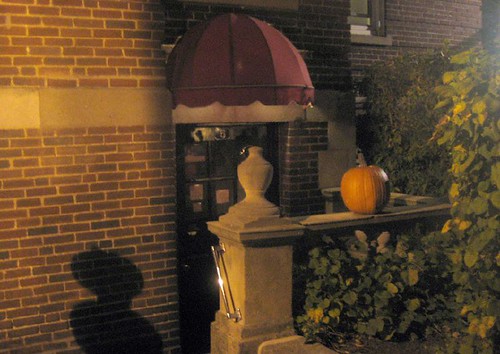


The new restaurant,
Craigie on Main, opens around November 14.

Labels: , , , , ,

Sunday, October 19, 2008

Racing bacon

We'd decided that the Big E was just too far to drive this year, even for hearty quantities of fried fairground food. However, Topsfield Fair was a more convenient destination, so we both took a rare day off work and went up on Friday to avoid the weekend crowds.

The food options turned out to be disappointing: we had passable corn dogs and fries with reconstituted gravy, though we did find an apple crisp with real fruit and a good cinnamon-scented buttery oatmeal topping.

But let's get real: we weren't there for the food. And while the llamas and goats and fancy show chickens and angora rabbits and Shetland ponies and falcons and ducks and Shire horses and bees were cool, we weren't there for them either.

Nor was this trip based around a desire to see the
prize-winning 1,400-pound pumpkin.

Nope. It was all about Robinson's Racing Pigs.

We were at the track 15 minutes early and picked out a good spot on the turn, so we'd have a view of both the straightaways and the central water tank. Next to us was a tiny white-haired old lady, quite giddy with excitement, who told us she came every year just to witness this event.

The crowds gathered. The moment approached. And then, sadly, my camera died. Luckily, many other people have recorded before me, so I gratefully bow to their superior battery power.

And then the theme song began.


That should give you a pretty good idea of what was coming, no?

The premise of the show was this: the barker (possibly Robinson himself, though more likely a protegee in the Dread Pirate Roberts vein) herded four pigs into the starting gate. Then he divided the audience into four groups, chose a representative from each, and assigned them a pig, which he named according to a topical pun (e.g. Lindsay LoHam and Britney SpareRibs). The groups then were to yell encouragement to their pig, with the victorious assignee winning a voucher for a free slushy.

(Worth noting: when the pigs were given political-candidate names, 90% of the crowd rooted for BaRack-of-Ribs Obama. This is Massachusetts, after all.)

The pigs, for their part, were motivated by Oreo cookies waiting at the finish line: first piggy home got to snarf all the cookie before the others arrived, like this:


And then there were the swimming races:


I felt a little guilty watching the piggies perform for the benefit of baying crowds, I must admit. But then I remembered that the previous night I'd had braised pork shoulder with collards at Highland Kitchen, so really I was in no position to pass judgement.

Labels: , , ,

Tuesday, October 14, 2008

Disputing the theories of a Nobel ecomonist

Happy news this week was that Paul Krugman won the Nobel Prize for Economics. The Boy was in Krugman's International Trade class at MIT and has been getting a kick out of his New York Times blog (which, unsurprisingly, has been particularly entertaining of late).

But while Krugman might be all Nobellian when it comes to trade theories, I have to take him to task about a 1998 piece he wrote called
Supply, Demand, and English Food. In it, he discusses how the greasy, gelatinous joke that is allegedly British cuisine is the result of population movement during the industrial revolution:

A good guess is that the country's early industrialization and urbanization was the culprit. Millions of people moved rapidly off the land and away from access to traditional ingredients. Worse, they did so at a time when the technology of urban food supply was still primitive: Victorian London already had well over a million people, but most of its food came in by horse-drawn barge. And so ordinary people, and even the middle classes, were forced into a cuisine based on canned goods (mushy peas!), preserved meats (hence those pies), and root vegetables that didn't need refrigeration (e.g. potatoes, which explain the chips).
He goes on to argue that the English continued to eat slop because they didn't know any better:
... by the time it became possible for urban Britons to eat decently, they no longer knew the difference. The appreciation of good food is, quite literally, an acquired taste--but because your typical Englishman, circa, say, 1975, had never had a really good meal, he didn't demand one.
You can see where I'm going, can't you?

It is true that British cuisine has been a punchline for a long time. But I submit that this is completely unwarranted and based largely on experiences in tourist-trap restaurants in London. If you wander into an overpriced pub in Leicester Square looking for lunch, then yes, you'll get a deep-fried sausage and frozen chips and canned vegetables. It's not as though you're likely to be a repeat customer. Thanks for your money; have a safe flight home.

However, those of us who grew up on English cuisine know that the menu extends far beyond fish and chips and mushy peas--and has always been thus.

I'm thinking about Sunday lunch: roast chicken with sage-and-onion stuffing, buttery mashed potato, fresh steamed carrots, Yorkshire pudding and gravy.

I'm remembering my mum's curd tarts, apple crumble, triple chocolate cake, bread pudding. And my grandmother's Welsh cakes, rice cake, tea breads, and especially her dark, dense, brandy-soaked Christmas cake.

I'm having flashbacks to summer picnics on the North York Moors: overstuffed sandwiches of ham, cheese, tomato, cucumber, lettuce; hard-boiled eggs; homemade cupcakes; strawberry blancmange in individual pudding cups.

I'm thinking of all the foods I crave that are hard to come by in the US: cornish pasties and scotch eggs, and real rice pudding (baked in the oven with butter and cream), and Danish bacon, and Cumberland sausage, and not having to buy rhubarb or apples or blackberries because they grow in your back yard, and cream cakes made with fresh cream (eclairs and napoleons and strawberry tarts).

And here's the thing: I've lived outside England for 15 years now. I've traveled to Paris and Montreal and various tropical islands. I've eaten in New York and San Francisco and Miami, not to mention some of the most respected restos right here in Boston.

By Paul Krugman's measure, I now "know the difference."

And yet I'd still go for a nice Melton Mowbray pork pie in an instant.

I was going to stop there, but here's another thing: it's not as though all traditional American cuisine is fantastic. Of course there are pockets of regional deliciousness, but then again this is a very big country; by comparison, the UK is about the size of Minnesota. I'm sure Minneapolis today has some fantastic restaurants, but was that true in 1975?

And from a grease perspective, fish and chips don't hold a (tallow) candle to a Philly cheesesteak.


What do you think?

Labels: , ,

Saturday, October 04, 2008

The new Sel de la Terre: Loud as he** in there

This week we went to check out the newest branch of Sel de la Terre, the (slightly) more affordable sister restaurant to L'Espalier. We like the original Sel, by the Boston Aquarium, for its relaxed elegance; it's a nice place for an intimate dinner. And while we've only been to the Natick branch for brunch, that location has the same atmosphere of grace and ease.

These adjectives were evidently not in the plans for the new Boylston Street branch of Sel de la Terre. This place is not meant for quiet tête-a-têtes or laid-back suppers. It's where you go to see and be seen—or, more accurately, to yell and be yelled at.

Here's the deal: it's one big open room. The floor is polished marble; the walls are exposed brick; the ceilings are high and open. Also open is the kitchen, from which, as you'd expect, comes a constant chorus of metal and sizzle and call-and-response.

So sound bounces off every surface, with nothing to baffle it. The noise level is high to the point of being obnoxious.

I figured out why I find this so annoying in restaurants: it makes me less able to concentrate on my food. Yes, of course I can multi-task and process more than one sensory input at a time. But I like being able to focus on the way ingredients play together; on the dance of flavors and textures; on how well the wine pairs with the food.

And frankly, I'd hope that a chef would want to support that desire. Why go to the trouble of crafting a carefully structured dish, of balancing notes and themes, if you then distract your diners? It's like asking people to admire a Seurat painting and then launching Nerf balls at their heads.

In The Boy's case, there were extra distractions: the air-conditioning vent in the ceiling above us was dripping condensation onto his head.

And that's before we encountered our waiter. He was one of a type: he tells you how wonderful everything on the menu is, even after you've ordered (please! You can stop selling now!). He asks what kind of water you prefer, and then forgets to bring it. He interrupts your conversation, rather than waiting for a pause, to ask questions ("How is everything? Awesome? Awesome!').

And perhaps the noise level also broke his focus, because he got the order wrong. He wrote down one thing but asked the kitchen for something entirely different.

Later, he came over with the cheese plate. One of the selections fell off the plate and onto a chair. He picked the cheese up, put it back on the plate, and proceeded to introduce the selections to us as though nothing had happened.

Now I know there's a reasonable chance that this plate was just for show, and that they had the serving cheeses somewhere in the back. But still, we passed.

This said, the food was good. The charcuterie included honey-drizzled foie gras terrine, which is a genius combination, and andouille sausage wrapped in bacon, as though someone had thought, You know, there's just not enough pork here. How could we add some more?

I had lavender-scented chicken breast—the chicken itself was a little dry (gasp!) and the floral note was so subtle as to be almost invisible, especially when contrasted with the bold, creamy, Serrano ham and squash risotto.

The Boy's pork chop, when it finally arrived, was juicy and delicious, seasoned with a lively five-spice blend and served with a tasty leek-and-potato cake.

Would we go back?

If this was the only Sel de la Terre in Boston, we'd give it a second chance; the quality of the cooking is high enough that we'd try again, perhaps at an earlier time (I assume it's less riotous early Sunday evening). But as we're already happy with the State Street branch, I think we'll keep that as our default. Their insanely good rosemary frites provide quite enough sensory overload.

I wrote a poem about the new Sel de la Terre. Wanna hear it? Goes like this:

Labels: , , ,