Thursday, January 22, 2009

The final word on fish and chips

I know, I need to move on from the fish and chips obsession. But since my review of The Battery in Brighton, I've been looking for ways to explain just what makes good fish and chips so good.

And it's hard, for two reasons:

I have an emotional attachment to fish and chips
It's not just a meal in isolation: it means driving to the seaside (Seaton mostly) with my parents and sitting in the car, eating chips, and watching the rough, gray waves of the North Sea. It means walking to the chip shop on a Friday night to get fish-and-chips-three-times-and-a-pineapple-ring (my favorite), and then running home with a warm bundle wrapped in newspaper. It means schoolyard discussions on the subject of
scraps, and whether they were necessary. It's Proustian, but with more malt vinegar.

The basic description sounds gross
It's true. Deep-fried fish in batter, served with fat chips that are best if there's no crunch, no hard bits, just a pale, soft wedge of potato, all sitting on a piece of wax paper turned translucent from the grease. Yum? No.

Luckily, the Guardian came through for me this week, with an
article about the Best Fish and Chip Shop of the Year 2008 award and a description that perfectly encapsulated the essence of fish and chips:
And to my way of thinking, the papery rustle of chips, the golden brown of autumn leaves, the exquisite crunch of crisp batter, the little puff of steam bearing the sweet promise of cod or haddock (sustainably sauced, of course) that escapes as you break through the batter carapace for the first time, the slippery collops of hot, lucent, white fish slipping between your fingers into your mouth, the tang of vinegar, the rasp of salt, the gloss of fat on the lips – don't tell me that these aren't the equal to any gastronomic experience in any part of the world.
I really have nothing to add.

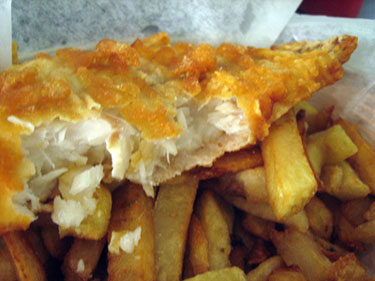
Oh, except this: As we were heading to Penn Station at the end of our NYC trip the other week, we made a pit-stop at
A Salt and Battery. It might not be real absolute proper fish and chips, but it will do for now.


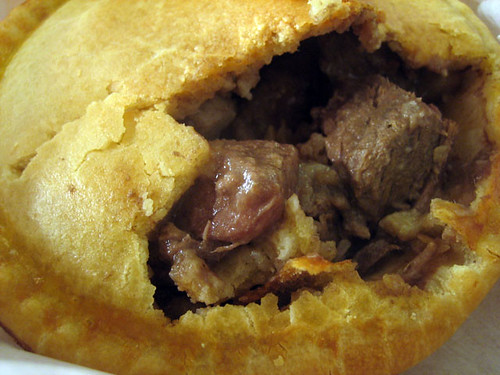
Their flaky, fabulous steak and kidney pie: beef gravy and pastry is one of the best combinations ever.


Sadly, we were too full for dessert:
Labels: , , , , , , ,

Sunday, January 18, 2009

Sensing restaurant, Boston: Guy Martin didn't bring the stars

In late 2007, I came across a blog post that caused me to squeal: Guy Martin was opening a restaurant in Boston, scheduled for December of that year.

I kept watch on the news, set up Google Alerts and all but tied the anticipatory napkin around my neck.

Why the excitement? Here's the lore: Guy Martin started collecting awards in 1985, whe he got his first Michelin star. In 1991, he became chef of
Le Grand Véfour, a 200-year-old Parisian resto that has served Napoleon, Sartre, Simone de Beauvoir, Colette. Over the next ten years, he was named Best Chef of something-or-other on an annual basis, culminating with Le Grand Véfour's promotion to three Michelin stars in 2000.

A
February 2000 Salon piece notes the importance of this event:
The big news is that chef Guy Martin at Paris' historic Grand Véfour has earned a third Michelin star -- with no losses among 1999's 21-strong three-star lineup. Conspiracy theorists have long believed that for a chef to get a third Michelin star -- the guide's highest rating -- someone at the top has to die or be demoted, so that the total will stay at 21.
Perhaps now you understand my excitement.

Construction wasn't even close to complete by the end of '07. But in a Feb '08 Boston Globe interview, Guy Martin further whetted my appetite:
"Sensing will be a destination for those attracted by a beautiful, fine, and subtle cuisine ... I want my customers to taste the ingredients. To give you an example, there will be dishes like oysters in a jelly made with seawater, or a horseradish blanc mange."
The week before this interview ran, we had an amazing meal at Adour, the latest New York project from Alain Ducasse, himself a three-Mich-star chef (in three different countries).

I was psyched. Sensing was going to be just as good.

Finally, after a few small business ownership-type hiccups, Sensing opened this week in the Fairmont Battery Wharf in the North End. So we went.

And. Um. Okay, one thing at a time.

Decor
In the Globe interview, Guy Martin says, "I want colorful and vibrant décor with a modern and contemporary look ... I truly want to give my customers a unique experience, visually as well as emotionally."

"Colorful and vibrant" translates to blond wood wall paneling, blond wood tables, and blond wood chairs with blue sage upholstery. If this is a "unique experience" I assume M. Martin has never been to a Marriott.


The place looked like the restaurant in a 1980s hotel chain; I could imagine that at the end of the night, the waitstaff set out individual jars of ketchup and grape jelly to go with the next morning's Western omelettes and homefries.


Service
I don't know whether this was the philosophy at Sensing or just our own waiter's approach, but what we got was a blend of half-Applebee's ("Hi-my-name-is-and-I'll-be-serving-you-this-evening") and half-steakhouse (The Boy was handed the wine list; all our choices were deemed "excellent"; I was addressed as "Miss").

Cocktails arrived halfway through the appetizers (though they were ordered before). Once our apps were cleared, we were asked if we'd like more bread, though we hadn't been given any to begin with. The dessert menu took a long time to arrive, and longer for anyone to circle back around to us. I'm hoping these are opening-week roadbumps, and will smooth out quickly.

Food
The great: Cocktails. Mine was a Cilantro Sting, a lovely, light, fresh blend of muddled cilantro, Patron Silver tequila, vodka and lime juice, garnished with a slice of serrano pepper. It's best enjoyed slowly, so that the heat from the chili disperses gradually into the drink. I will be making this at home.

The Boy had a Lemon Smash: rye whiskey, lemon juice and mint, a nice take on a julep.

Also good was my entrée: a fantastically lean and juicy loin of lamb, crusted with peanuts and served with light, fluffy sweet-potato gnocchi tossed with arugula. The peanut crust provided a nice comfort-food crunch but wasn't quite generous enough to stand up to the flavor of the meat, but otherwise it was well executed and lovely.

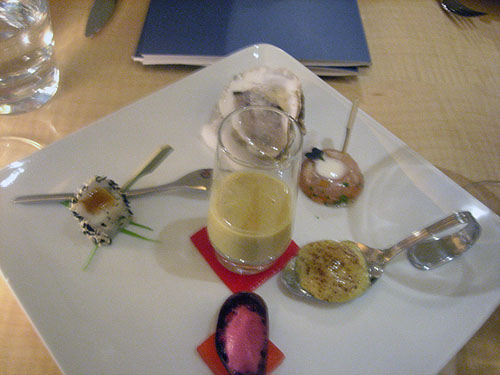
The not-so-great: the Snacking Platter. This six-item sampler promised an inventive taste adventure.


Clockwise from noon: Wellfleet oyster with shallot mignonette; king crab in grapefruit jelly; duck foie gras crème brulée; smoked mussel with beets; cheese maki; and, in the center, Jerusalem artichoke soup with ras-el-hanout.

The oyster was perfect. The crab item held a faint hint of citrus and nothing more (certainly no crab). The crème brulée was creamy genius. The smokiness of the mussel played nicely against the sweet beet, though the square of beet jelly underneath was a chewy cypher.

The maki was exactly what you'd expect from a mild cheese paired with white rice; a bland, soft mouthful appropriate to feed to invalids.


And the soup, though comfortingly warm and rich, didn't give much sense of either girasole or spice complexity. Ras-el-hanout is one of my favorite blends but was barely distinguishable here.

The Boy ordered chicken—an unusual choice for him—but this was stuffed with smoked trout, which is certainly a departure from the mainstream. It's so hard to keep chicken breast moist, and even here it was dry, with the trout providing necessary moisture. It was an interesting experiment, but ultimately came off as no more exciting than smoked chicken.

A couple more notes, just because they bugged me: the wines by the glass were limited—four red, four white—and were mostly domestic (or, as it read on the wine list, from "Usa"). Really? A French-helmed resto that can only scare up a single Lalande de Pomerol?

The menus were listed on printer paper haphazardly glued onto card stock in a way that suggested cutting costs was more important than presentation. The drinks menu categories were "Cocktails," "Elegance," "Sublimation" and "Pure"—yes, very cool and hip, but can you just tell me where the wine is?

I didn't want to like Sensing. I wanted to fall in love with it, to be able to add it to the list along with L'Espalier and Raduis, with Rialto and Craigie. Given Guy Martin's résumé, Sensing should be the best restaurant in Boston; instead, it's on par with Rendezvous or Central Kitchen, except it costs twice as much.

I assume Martin did some research before coming here. I'm sure he didn't intend to half-ass Sensing on the premise that Boston isn't New York and the rubes wouldn't know any different. But that sad thing is that what he has created isn't on a par with Boston's best.

Sensing is not a bad restaurant. It isn't
Mercer Kitchen bad. But neither does it come across as scion-of-Michelin-star-genius good. At best, it's a reasonable hotel-chain restaurant.

Labels: , , , , ,

Saturday, January 03, 2009

Mercer Kitchen: representative Vongerichten?

Despite my recent critique of The Battery's attempt at fish and chips, I'm usually pretty positive in my appraisal of restaurants.

But that was before we went to Mercer Kitchen.

This Soho restaurant is part of the
Jean-Georges Vongerichten empire, which currently consists of 18 restaurants in New York, Vegas, London, Paris, French Polynesia, the Bahamas, Chicago and Minneapolis. Vongerichten's restaurants have earned acclaim from the New York Times and a scattering of Michelin stars.

And Mercer Kitchen is obviously a hip hang-out:
all manner of people seemingly famous for something have posed for photos there.

So what was our problem?

Well, let's see. It went like this:

We arrived at Mercer Kitchen early on a Sunday evening and were shown to our table. The basement space was open but intimate, spacious but cozy, and relatively quiet, with only about half the tables occupied.

We sat for fifteen minutes while our waitress and a couple of busboys circulated around our area. Eventually, I caught the eye of a busboy, who poured water.

Five minutes later, our waitress came over. "Can I interest you in sparkling, still, or tap water?" she asked. We pointed out that we already had water. "Okay, then I'll bring your menus."

Five minutes later, she was back with menus. "Can I start you off with a cocktail?"

We explained we'd like a moment to look at the cocktail menu.

Twenty minutes later, she came back, by which time we'd decided on everything, almost. I asked which wine she'd recommend to go with my chosen entree. "Well, do you prefer something sweet?" I said I'd prefer something that matched my food, and she pointed me—interestingly—toward the cheapest thing on the list.

We ordered cocktails, apps and entrees.

The appetizers came first. I had a tender, melty sea bass carpaccio that would have been perfect if I could have tasted the fish through the overpowering lime juice. It came with herbed, salted foccacia breadsticks, for no apparent reason; they were probably the best thing about the dish.

The Boy ordered a shaved fennel salad that was topped an embarrassment of parmesan, more than he could handle—and when The Boy says there's too much cheese, you know it's serious.

Halfway throughour apps, the cocktails arrived. My glass was so full, our waitress couldn't help but spill it as she set it on the table, splashing it unapologetically onto my wrists and my food.

At least the cocktails were okay, if unremarkable; maybe I've become spoiled, but I'd expected something a little more creative than the cucumber-Hendrick's martini (so 2006! So summer menu!).


After a reasonable time, our entrees arrived. The Boy's duck was lovely, and came with wild rice and an intriguing salad of preserved lemon and pistachios. My skate was good, but the sides were tasteless, out-of-season asparagus and a too-too-sweet sesame sauce. I finished the fish, tried a little of everything else, and gave up.

And then our waitress brought the wine.

And it wasn't good. Sadly, I don't remember what I ordered, but I do remember that I didn't finish the glass. Yeah, that bad.

We sat for ten minutes with our dirty plates, and then managed to get our waitress to bring the check.

"Thanks, guys," she said, and added, by way of apology. "We were kinda backed up tonight."

Which was, of course, patently ridiculous: the place was hardly jumping. There were empty tables all around us and no large parties. And the back-up wasn't in the kitchen, because our food arrived on time.

So what to make of this? Is it a management issue; a problem with communication? Did we just get the particularly sketchy waitress? Should she perhaps have spent less time refilling water glasses (when there were already two other people assigned to that task) and more time monitoring her tables' progress?

Of course, our main takeaway is that we now have no interest in trying any of the other restos in the Vongerichten empire; if the service at Mercer Kitchen is any indication of business philosophy, and if the dishes elsewhere are equally as undistinguished, there's really no reason to waste our time.

(While writing this, I came across a
New York Times review of Mercer Kitchen from 2006; I really wish we'd read it before we booked. Apparently nothing has changed.)

Labels: , , , ,